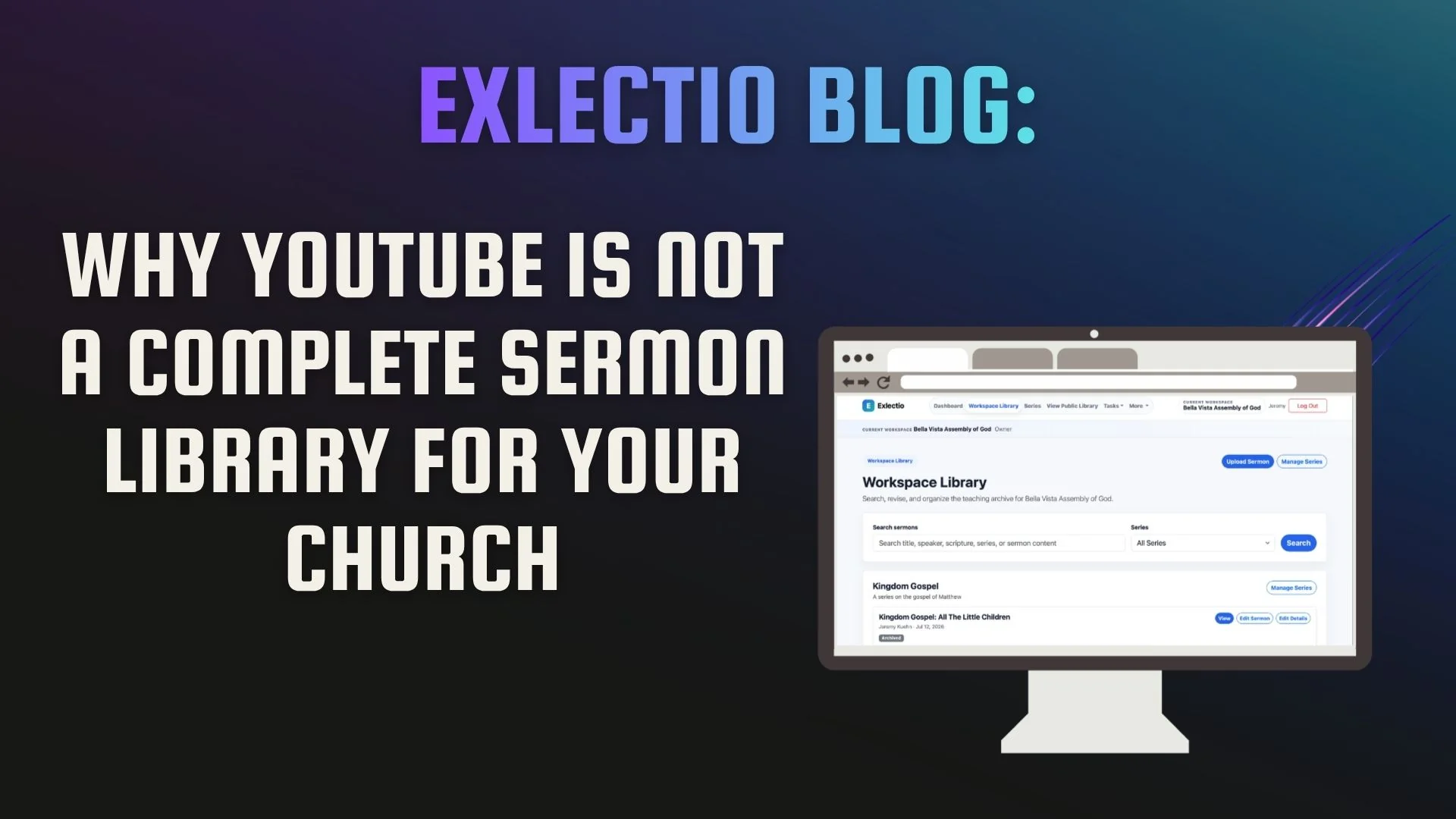
Why YouTube Is Not a Complete Sermon Library for Your Church
Your church should absolutely be on YouTube. It just shouldn't stop there.
For years, I assumed uploading sermons to YouTube was enough.
Every Sunday we recorded the message, uploaded it, added a thumbnail and title, and moved on to the next week. Like many pastors, I believed I was building a library of our church's teaching.
Over time I realized I wasn't building a library at all.
I was building a collection of videos.
That realization eventually became one of the reasons I built Exlectio.
This article isn't about why churches should stop using YouTube. I don't believe they should. We still publish every sermon there because YouTube is one of the best ways to help new people discover your church.
The problem is that YouTube wasn't designed to preserve years of biblical teaching for discipleship. It was designed to distribute videos. Those are two very different goals.
Where YouTube Is Extremely Helpful
Before talking about YouTube's limitations, it's worth recognizing what it does incredibly well.
YouTube is the second-largest search engine in the world. It introduces new people to your church every day, works on nearly every device, handles video streaming better than almost anyone, and allows people to subscribe and receive notifications when new sermons are published. Those are enormous strengths. If someone searches "Christian sermon on anxiety," they may discover your church for the first time because of YouTube. That's a win. Every church should take advantage of that reach. But reaching people and preserving your teaching aren't the same thing.
Where YouTube Begins to Break Down
Imagine you're preparing a sermon on Romans 8.
You remember preaching from that chapter three years ago.
Can you find it?
Maybe.
You might scroll through months—or years—of videos hoping to recognize the thumbnail.
Now imagine you want every sermon your church has ever preached on prayer.
Or every message from the Gospel of Luke.
Or every sermon in your "Teach Us To Pray" series.
That's where YouTube begins to struggle.
It wasn't built to organize teaching around Scripture, topics, speakers, or series.
It organizes videos.
Churches need something different.
They need to organize teaching.
Videos Aren't the Whole Sermon
One of the biggest lessons I learned is that the sermon video isn't actually the sermon.
The sermon includes the manuscript. The Scripture references. The study notes. The series. The topics. Sometimes discussion guides. Sometimes handouts. Sometimes revisions made before publication.
Those things disappear when all that's left is a YouTube video.
That's one of the reasons Exlectio preserves the original sermon manuscript alongside the published version. The video becomes one part of a much larger teaching resource rather than the only surviving copy.
Learn More in Exlectio
People Search for Teaching, Not Videos
Think about how people actually remember sermons.
Nobody says,
"I'm looking for that sermon from March 17th."
Instead they say,
"Didn't Pastor preach something from James?"
or
"What was that message about forgiveness?"
or
"What series did we do on prayer?"
A church library should let people search the way they naturally think.
That means organizing sermons by:
- Scripture
- Topic
- Speaker
- Series
- Keywords
Instead of hoping someone remembers a thumbnail or publication date.
(Insert screenshot of Exlectio search results.)
Learn More in Exlectio
- Organizing Sermons with Series and Tags
- Searching Your Sermon Library
Keep Your Teaching on Your Church's Website
One lesson I've learned over the years is this:
Your church website should be the home for your church's teaching.
YouTube should help people discover it.
When someone visits your church's website, they should be able to search sermons, browse series, find messages by Scripture, and explore teaching without leaving your church's online home.
That's difficult to accomplish if everything lives exclusively on YouTube.
A searchable sermon library embedded directly into your website keeps your teaching connected to the rest of your ministry.
Visitors can move naturally from sermons to ministry pages, small groups, events, or your plan-a-visit page.
Learn More in Exlectio
The Best Approach Isn't YouTube or a Sermon Library
It's both.
I still publish every sermon to YouTube. I probably always will.
YouTube is an incredible distribution platform.
But after the sermon is published there, it also belongs in a searchable teaching library where the manuscript, Scripture references, topics, tags, and series stay connected.
One platform helps people discover your church. The other helps people continue growing through your church's teaching. Those aren't competing ideas. They're complementary.
YouTube vs. a Searchable Sermon Library
(Insert comparison table.)
| Feature | YouTube | Searchable Sermon Library |
|---|---|---|
| Video hosting | ✅ | Optional |
| Reach new people | ✅ | Limited |
| Search by Scripture | ❌ | ✅ |
| Search by topic | ❌ | ✅ |
| Browse by series | Limited | ✅ |
| Preserve manuscripts | ❌ | ✅ |
| Store sermon notes | ❌ | ✅ |
| Keep revision history | ❌ | ✅ |
| Generate discussion guides | ❌ | ✅ |
| Embed on church website | Limited | ✅ |
Steward the Teaching God Has Given Your Church
Every sermon represents hours of prayer, study, and faithful ministry. Those messages deserve more than becoming another video in a playlist. YouTube is one of the best tools available for sharing your sermons with the world. But your church's teaching deserves a permanent home where it can remain organized, searchable, and useful for years to come.
The best churches don't choose between YouTube and a searchable sermon library. They use each for what it does best.
Build a Searchable Sermon Library
Exlectio helps churches preserve original sermon manuscripts, organize sermons by Scripture, topic, speaker, and series, and publish a searchable sermon library directly on their website—all while continuing to use YouTube as their video platform.
Start building your sermon library today →
Continue Reading
- How to Build a Searchable Sermon Library for Your Church
- How to Organize Church Sermons by Scripture, Topic, Series, and Speaker
Frequently Asked Questions
Should churches still upload sermons to YouTube?
Absolutely. YouTube is one of the best ways to reach new people and make sermon videos easily accessible. The issue isn't using YouTube—it's relying on YouTube as your only sermon archive.
Can I embed YouTube videos into a sermon library?
Yes. A searchable sermon library can use YouTube as the video source while adding manuscripts, Scripture references, tags, and other teaching resources that YouTube doesn't organize well.
Why should sermons be searchable by Scripture and topic?
Pastors and church members usually remember what a sermon was about rather than the date it was preached. Organizing sermons by Scripture, topic, series, and speaker makes years of teaching much easier to find and reuse.
Should sermons live on our church website?
Your church website should be the primary home for your teaching. YouTube is excellent for distribution, but a searchable sermon library gives visitors a richer experience and keeps them connected to the rest of your church's ministries.
Regards,
Jeremy Kuehn