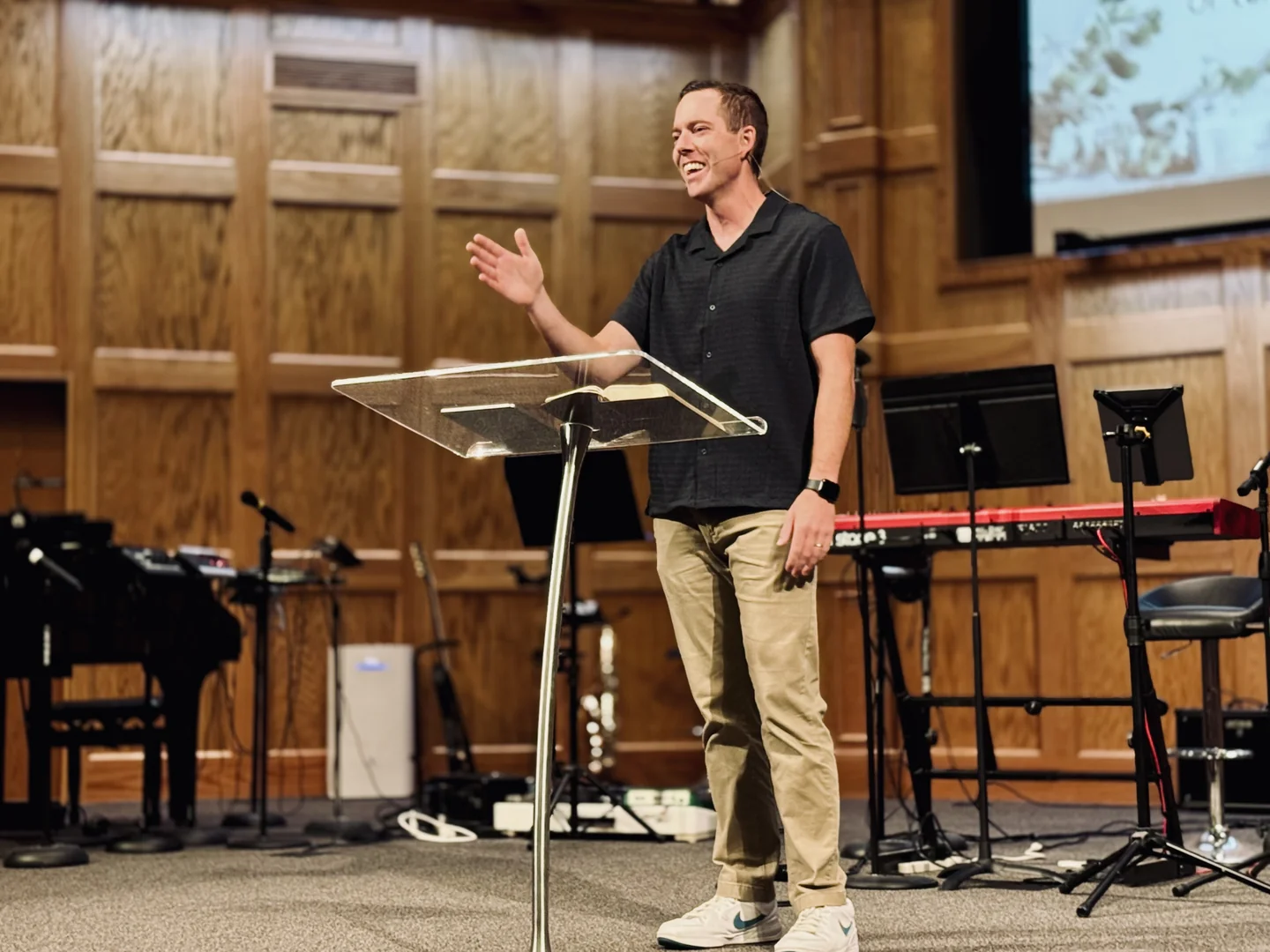
Sermon
For the past two weeks, we have been going through a series on family.
One of the questions I continually ask myself is how do I speak to everyone in the room? All of us have a different set of life experiences and are at different stages of life. But one thing unites us all: we are all in a stage of family.
From the youngest child in the building to the most experienced grandparents: the husband and wife, son and daughter, aunt and uncle, we are all in a stage of family.
Every family needs a biblical foundation for how to navigate conflict, how to decide whom our family serves, and this week we are looking at power dynamics in the family.
All of us want what we want.
Power is a word that can instantly make you uncomfortable, especially in the home, because most of us didn’t learn about power from healthy examples or experiences.
Power, simply defined, is the ability to overcome resistance.
Better defined in the family dynamic, it is the ability to influence the behavior of others.
Not all power is bad. In fact, sometimes when you combine the power of one person with the power of another, you can create something special.
Story: This exact thing came together a few years ago.
My grandmother was visiting us in Nebraska, and it was bitterly cold and had been for about two weeks. One of the things my grandmother and I share is an enjoyment of fishing.
I remarked, “We should go ice fishing.” She grew up in Mississippi, so this had never even been an option for her. So we combined our powers.
She had the power to buy all the fishing gear. I had the power to drill the holes and walk on the ice.
I gave her some yak-tracks, and off we went.
When power combines, something beautiful happens.
When power competes, something often breaks.
Where the rubber meets the road, we find out that every family has power dynamics, whether we acknowledge it or not.
This means that power struggles are universal and unavoidable.
Every stage of family deals with it.
Power is not evil, but it is unavoidable.
Every stage deals with it:
Power exists because relationships exist.
From the beginning, Scripture shows us this tension. Before the fall, man and woman walked side by side. After the fall, power became distorted.
“You will desire to control your husband, but he will rule over you.” Genesis 3:16B NLT.
God tells us right there that power would no longer be about partnership but about position.
So the question isn’t, “How do we eliminate power from the family?” Because it's not going away.
The real question is, “How do we redeem it?”
Jesus, in Mark 9, completely redefines power.
Let’s step into that moment together.
The disciples are arguing again about who is greatest. Same pride. Same insecurity. Same power struggle. Jesus doesn’t scold them publicly.
He sits down, the posture of a teacher, and rewrites the rules. Let’s read it together.
“After they arrived at Capernaum and settled in a house, Jesus asked his disciples, ‘What were you discussing out on the road?’ 34 But they didn’t answer, because they had been arguing about which of them was the greatest. 35 He sat down, called the twelve disciples over to him, and said, ‘Whoever wants to be first must take last place and be the servant of everyone else.’” Mark 9:32-35 NLT.
Then he does something unforgettable. He pulls a child into his arms and gives us three defining truths about power in God’s kingdom.
“Whoever wants to be first must take the last place…”
In God’s design, power is not about position; it’s about posture.
The one with the most authority:
Biblical leadership doesn’t ask the question, “How do I win?” It asks, “How do I serve?”
This is the antidote to domination, manipulation, and ego-driven leadership in the home.
Power goes last because we are called to serve. Jesus also teaches his disciples…
“Then he put a little child among them. Taking the child in his arms…”
Children, in that day, had no status, no leverage, and no voice.
Notice the position of the child. Jesus doesn’t place the child beneath them. He places the child at the center.
This isn’t to teach that children are the center of the universe because certainly they are not.
Power in God’s design does not distance itself from weakness; it draws it near.
This applies to:
Power that serves doesn’t push people away; it protects them.
In the kingdom of God, the disciple goes last because the disciple is called to serve. Further, the disciple not only goes last but uses their power to protect the vulnerable. Finally, we learn that…
“Anyone who welcomes a little child like this on my behalf welcomes me, and anyone who welcomes me welcomes not only me but also my Father who sent me.” Mark 9:37 NLT.
Here is what I believe Jesus teaches as the purpose of redeemed power:
Even the world recognizes this principle. Psychologist Abraham Maslow observed in his hierarchy of needs that human flourishing is impossible without safety and security. Before a person can thrive, they must know they are safe physically, emotionally, and relationally.
In the same way, spiritual growth in a family requires an atmosphere of safety.
Here’s the bottom line:
That is redeemed power.
Power goes last, protects the vulnerable, and points others to God.
So what might this look like in our families?
Ask A Better Question:
In fact, I find the best way to get my way is to make sure some others get theirs. Then I have zero guilt about when I get my way.
Instead of quick correction, sit, listen, and lead.
Sit with the other person long enough to truly be with them. Too often we’re more focused on what comes next than what is in the moment.
Listen longer. Ask to understand, not so you can be understood.
This allows you to lead with presence before instruction.
To be clear, I am not talking about gentle parenting! I’m talking about the kind of parenting and relationships that HEAR and hold the standards of Christ.
Gentle parenting is for the birds. I’ll endorse gentle parenting when we live in a gentle world. Until then, I’ll endorse Power Parenting!
The goal isn’t behavior modification; it’s heart formation.
Because in God’s design:
Why does this really matter?
When a family redeems power, the world sees the gospel in motion.
Strong families are not defined by the absence of conflict; they’re defined by maintaining their witness in the midst of it.
And when families live this way, the world sees something rare:
Power that goes last.
Power that draws close.
Power that helps others grow.
That is the power of Christ.
And that is the power our families are meant to display.
Salvation