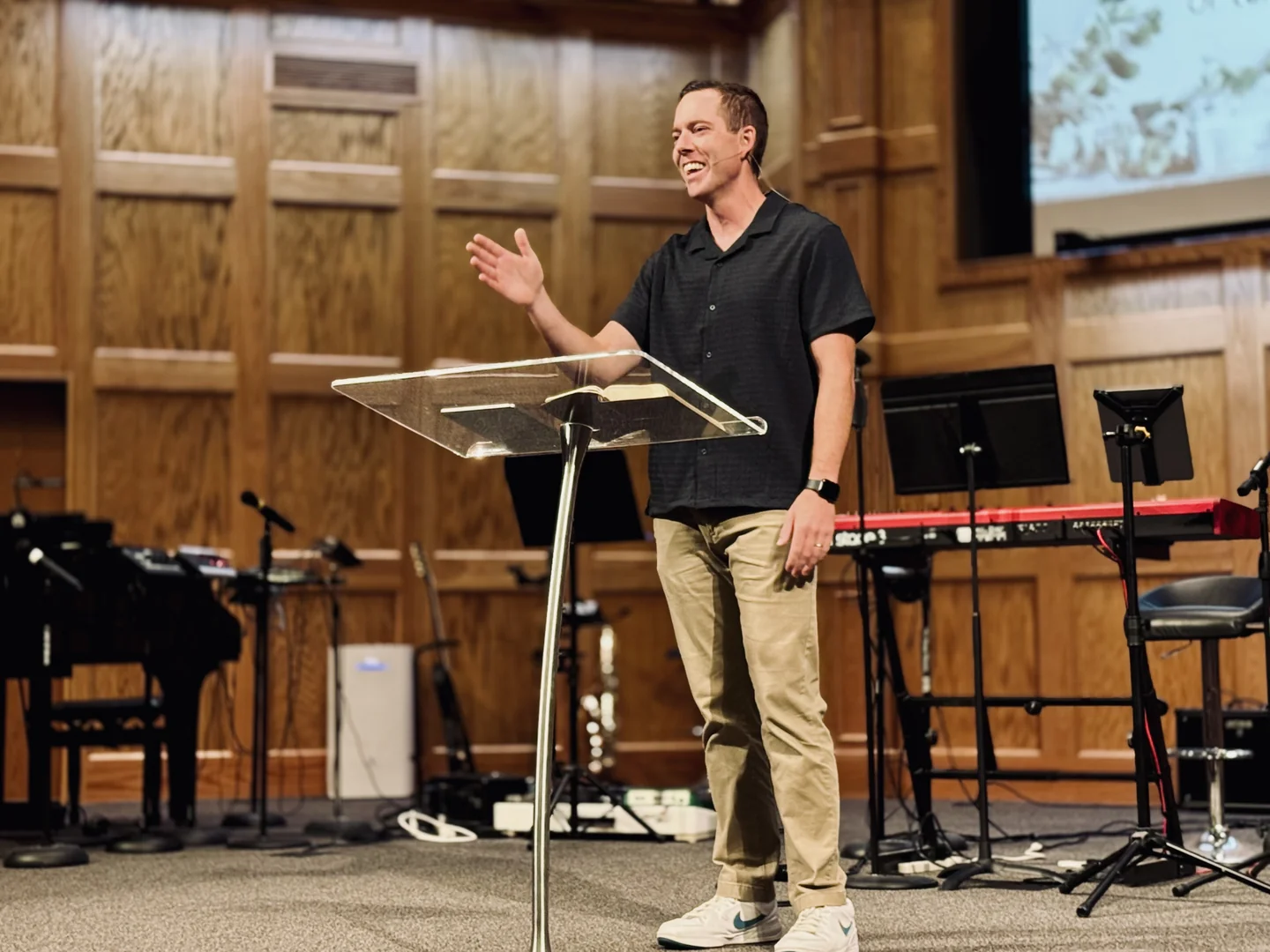
Sermon
Serving God as an individual is one of the easiest things I do.
I don’t struggle to read my Bible. I don’t struggle to pray. I don’t struggle to go to church.
In fact, growing up in church was where most of my friends were. I realized at a pretty young age that every year the school system wasn’t going to prioritize my friends and me to be in the same class. In fact, I’m sure they tried to separate my friends and me from the general population.
I vividly remember going to youth camp and Wednesday night youth.
In fact, the first time I ever volunteered in church, I was asked to not come back. I thought it would be funny to put a clear piece of tape on the sink sprayer so that when someone turned on the sink, they would get sprayed with water.
Springdale First Assembly of God had great water pressure, and my plan worked out really well to the detriment of someone else. In all honesty, I didn’t have much to contribute at 13.
But serving God as a family is much harder than I expected.
It’s not that we don’t want to serve God; we do. But life is loud, and a lot of things are clawing for our attention.
Distractions, schedules, fatigue, good opportunities—none of them are evil, but all of them compete.
Keep that in mind: most of these things are, in fact, not inherently evil or sinful.
If I’m not careful, the things meant to support my family slowly begin to lead my family.
What I’m really getting at is that the hardest part of family discipleship isn’t believing in God; it’s deciding who gets first place when everything else is pulling for attention.
Why is serving God as a family such a struggle?
That question isn’t new—and we’re not the first generation to wrestle with it.
Since the beginning of time, humanity has struggled to remain faithful to God.
Whether it's distractions, pride, curiosity, or outright sin, there is always something trying to take the place that belongs to God.
I believe nowhere is that more visible, or costly, than in the family.
Here’s why this is such a big deal.
The direction of the family today sets the tone for the next generation tomorrow.
What we prioritize now becomes what they normalize later.
So let’s go to a moment in Scripture where God speaks directly into that tension.
Turn with me to Joshua chapter 24.
I want to give you some context about this chapter.
Joshua is at the end of his life and leadership, and they have been greatly blessed by God. They’re literally living the promises of God in their generation. But Joshua knows Israel's history. He knows they have struggled to keep God's commandments. He knows they, like we often do, drift when life gets comfortable.
Joshua understands and wants them to know the land they now live in is not earned; it’s been given by God.
He’s trying to convey to them that blessing without remembrance always leads to distance from God.
With all of that history in mind—with blessing, drift, and choice in the background—Joshua draws a line.
“But as for me and my family, we will serve the Lord.” Joshua 24:15B NLT
The tension we have to face today is, regardless of what everyone else is doing, regardless of what is easy or hard, will our families serve the Lord?
Let’s pray.
Let’s walk through this text together.
“As for me and my family.”
When we study families in Scripture, one immediate truth we find is that it is really hard to find a “nuclear” family in Scripture. In fact, it is way more normal to find a blended family, and this is nothing new.
We find families that are blended, broken, redeemed, and rebuilt.
That tells us something important:
God’s covenant was never built on family perfection. It was built on the family's pursuit of God.
However, we do find that a relationship with God is more optimal when it is a household matter. We find this in the Old and New Testament. In fact, when Paul and Silas share the gospel with their prison guard, they don’t limit the gospel to the guard. They say, “They replied, ‘Believe in the Lord Jesus and you will be saved, along with everyone in your household.’” Acts 16:31 NLT.
A relationship with God, when possible, is meant to be a shared family commitment, not a private individual relationship.
Transition: Joshua doesn’t just name who is involved—he makes clear what they’re going to do.
“We will serve.”
Everyone serves something. It is unavoidable, but the choice is optional.
The Hebrew word for serve is the same word God used when he told Adam to cultivate the Garden of Eden. It’s the same word used for forced labor in Egypt.
Here’s the reality: we either choose what we serve, or we serve what is forced upon us.
In fact, this is the foundation of one of the biggest moments in the Old Testament. When Elijah faces the people for the pagan worship, he says this:
“Then Elijah stood in front of them and said, ‘How much longer will you waver, hobbling between two opinions? If the Lord is God, follow him! But if Baal is God, then follow him!’ But the people were completely silent.” 1 Kings 18:21 NLT.
The real danger isn’t calling on God when times are hard. Most people do that. It’s forgetting Him when life is good.
Transition: But Joshua isn’t finished yet—because who you serve matters just as much as the fact that you serve.
“The Lord.”
He doesn’t say “a god.” He says the Lord.
Joshua is specific. Not a generic God, not a convenient spirituality. If you look up the Lord in the original language, it would say Yahweh.
This is one of the things I pay attention to when I hear someone, maybe someone on TV, like an athlete or politician, say, “thank God.” The question I ask is, which God?
Joshua names the covenant God who saved, provided, and sustained them.
Many things in this world parade around as God, and people treat them as such. This is not new.
Transition: Joshua didn’t say this as a theory. He said it as a decision. And now that decision comes home to us.
“As for me…”
No one can decide this for you.
No one can serve God on your behalf.
Spiritual leadership always begins with personal responsibility.
What can we decide?
We can put things in their proper place to put action to our decision. Unless a decision has action, it’s not a decision; it's a hope. Are you ready to go sacred cow tipping?
If God created the family before all these things, then all these things must come AFTER the family. The only thing created before family was the personal relationship with God.
Which is why I believe the first step towards a redeemed and rebuilt family is a redeemed and rebuilt relationship with Jesus.
Remember, the word “serve” is the activity you do.
How can we serve the Lord together?
If you’re in town and it’s Sunday, go to church. Nothing replaces a community of faith.
Make the word of God present in your home and conversations.
“Keep this Book of the Law always on your lips; meditate on it day and night, so that you may be careful to do everything written in it. Then you will be prosperous and successful.” Joshua 1:8 NIV.
If you have the blessing of kids at home, read them an age-appropriate Bible story. Ask them, “What did you learn?” I ask my kids that. Half the time, Haven says something like, “Noah builds boats.” But she’s hearing the word of God.
If we can schedule practices, games, work, and hobbies, we can schedule moments with God.
Let’s not let the apex of discipleship be a sermon.
Following Jesus is not a spectator sport—it’s hands-on.
Joshua didn’t wait for consensus. He didn’t wait for culture to change.
He drew a line and said:
“As for me and my family—we will serve the Lord.”
Now the question isn’t what will everyone else do?
The question is: what will we do—together?