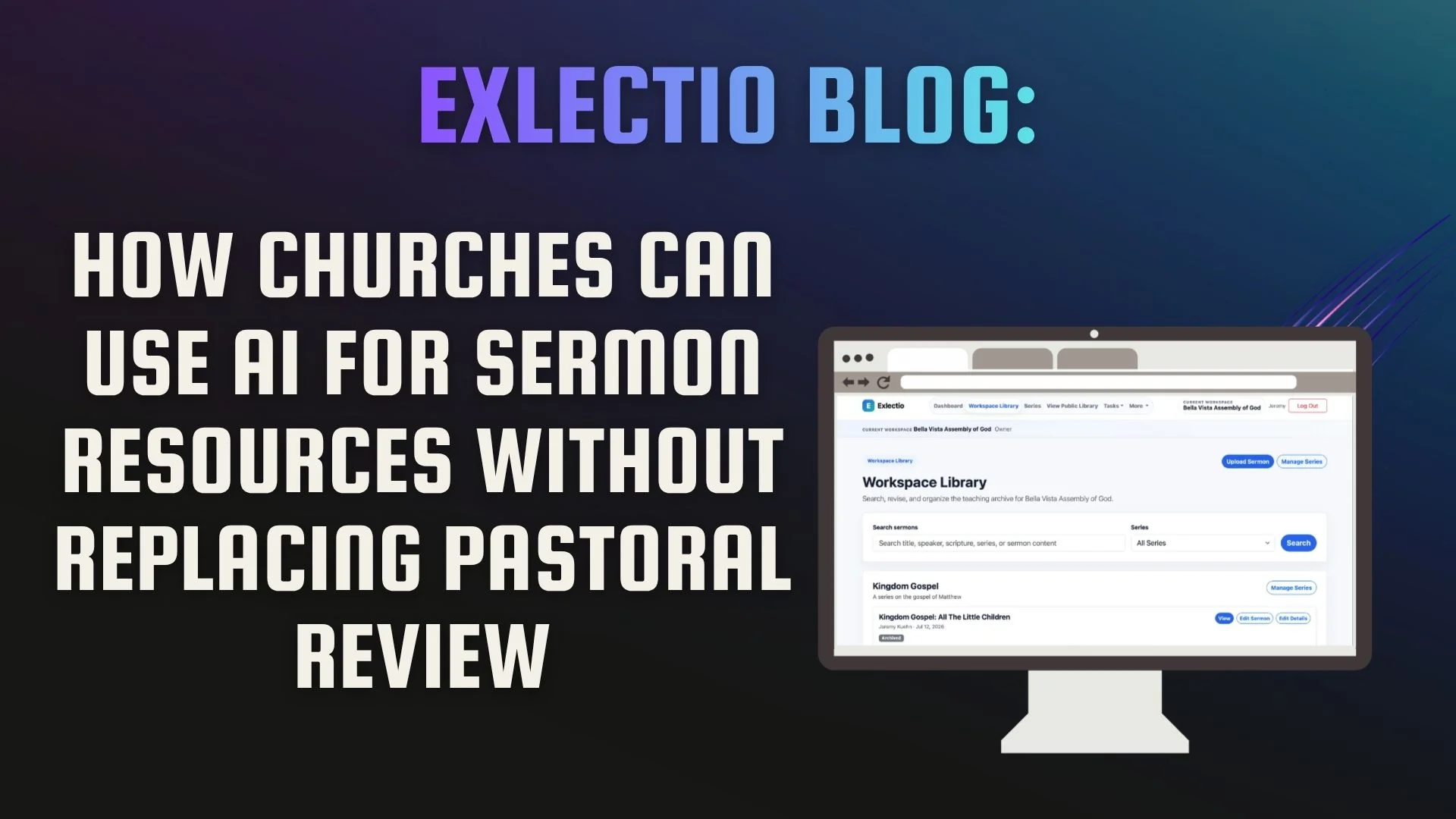
How Churches Can Use AI for Sermon Resources Without Replacing Pastoral Review
AI can help churches organize and extend sermon content, but it should never replace pastoral responsibility. Here's a practical workflow for using AI sermon resources while keeping theological review and publishing decisions in human hands.
Church leaders have always adopted new tools to help communicate timeless truth. Projectors replaced overhead transparencies. Church websites complemented printed bulletins. Sermon recordings became podcasts and video archives.
Artificial intelligence is simply the newest tool churches are evaluating—but it raises different questions than previous technologies.
The conversation around AI sermon resources is not primarily about efficiency. It is about stewardship. Pastors and ministry leaders are responsible for faithfully handling Scripture, communicating truth clearly, and maintaining the trust of the people they serve.
The most important question is not:
"Can AI create content?"
The better question is:
"What work should AI assist with, and where must pastoral responsibility remain?"
The answer begins with a simple principle:
No AI-generated output should ever be treated as automatically ready to preach, publish, or distribute.
Instead, churches benefit most from a workflow that preserves the original sermon, creates an editable working draft, involves thoughtful pastoral review, and only then shares resources intentionally.
The Real Concern: Control, Faithfulness, and Trust
Churches are not publishing marketing copy or product descriptions.
They are stewarding biblical teaching.
Every sermon represents hours of prayer, study, interpretation, and pastoral care. Church members trust that what is shared publicly reflects faithful teaching rather than automated content generation.
That makes human oversight essential.
Rather than asking AI to replace ministry work, churches can treat it as a constrained assistant that works from an existing sermon while leaving every meaningful theological decision in human hands.
Pastoral judgment remains responsible for:
- Biblical interpretation
- Theology
- Applications
- Tone
- Accuracy
- Final publication
Technology may assist with preparation, but it should never become the authority.
What AI Sermon Resources Can Appropriately Assist With
When AI works from an existing sermon source—and every result is reviewed by a person—it can reduce repetitive editing work without changing the message itself.
Appropriate uses include:
Correct obvious writing issues
An editable draft can help correct:
- spelling
- grammar
- punctuation
- inconsistent spacing
without changing the sermon's meaning.
Improve formatting
AI can help organize:
- headings
- paragraphs
- bullet lists
making a manuscript easier to read and archive.
Clarify fragmented notes
Many sermon manuscripts contain shorthand notes intended only for the preacher.
Where the intended meaning is already clear, AI can help make those notes easier to read while preserving the original intent.
Suggest useful organization
If supported by the sermon itself, AI may suggest tags that make future searching easier.
For example:
- Forgiveness
- Prayer
- Luke 11
- Discipleship
These suggestions should always be reviewed before acceptance.
Create editable discussion-guide drafts
Churches can also generate and edit small-group guides based on an existing sermon.
These guides are intended as working drafts, giving pastors and ministry leaders a starting point rather than a finished ministry resource.
Support future reuse
A cleaner manuscript is easier to:
- search
- archive
- revisit
- export as a PDF
- build future ministry resources from
These uses serve the pastor's existing message rather than replacing it.
What AI Should Not Decide or Publish
Every church should establish clear guardrails for how AI is used.
Within Exlectio's intended preserve-and-review workflow, AI should not:
- Invent sermon points.
- Invent illustrations.
- Invent applications.
- Invent statistics.
- Invent Scripture references.
- Add theological claims not present in the sermon source.
- Change doctrine.
- Change the sermon's primary message.
- Change the pastor's voice.
- Guess when wording in the original source is unclear.
- Decide that a sermon or discussion guide is ready for a congregation.
- Publish content without review and approval from a responsible person.
These guardrails keep technology serving ministry rather than directing it.
The Preserve → Draft → Pastor Review → Share Workflow
Responsible AI use becomes much simpler when every sermon follows the same workflow.
1. Preserve
The first step is preserving the original source.
Churches can upload a sermon as a PDF or DOCX.
Important principles:
- The original upload remains available for reference.
- Uploading does not publish anything.
- The source sermon remains the foundation for every future edit.
2. Draft
After text can be extracted, Exlectio creates a Markdown working manuscript.
If desired, churches can Use AI Cleanup.
AI Cleanup works from the current sermon revision and produces a separate cleaned working draft rather than overwriting the original.
Likewise, small-group discussion guides begin as editable drafts instead of final ministry resources.
3. Pastor Review
This is the most important stage.
Every result should be reviewed by a pastor or designated ministry editor.
Teams can review, edit, and restore sermons throughout the editing process.
During review, churches should verify:
- Scripture references
- sermon-point order
- theology
- pastoral voice
- illustrations
- applications
- wording that may still be unclear
If needed, previous revisions remain available for restoration.
Human review—not AI—is the quality control process.
4. Share
Publishing is a separate decision.
A sermon may be:
- approved but unpublished
- ready for review but still private
- intentionally published later
Churches can publish sermons intentionally when they are ready.
Discussion guides remain private drafts until they are intentionally shared. When a sermon is made public, its pastor-reviewed discussion guide can also become available as a downloadable PDF on the public sermon page.
Separating review from publication helps churches avoid accidental distribution of unfinished material.
How to Set Guardrails for a Church Team
Every church can establish simple practices that keep AI serving ministry rather than replacing it.
A practical checklist includes:
- Start with a complete and trustworthy sermon source.
- Assign a named pastor or ministry editor as the final reviewer.
- Clearly define what AI may assist with and what requires human judgment.
- Review every AI-generated or AI-cleaned draft before accepting changes.
- Compare Scripture references, theology, illustrations, and applications against the original sermon.
- Keep original sermon files and previous revisions available.
- Treat public publishing as a separate approval step.
- Give small-group leaders editable, pastor-reviewed resources rather than unreviewed AI output.
These guardrails are intentionally practical. Most churches do not need complicated policies—only a consistent review process.
Why the Original Sermon Source Should Remain Available
The original sermon is more than a backup file.
It is the reference point for:
- faithfulness
- future edits
- historical records
- ministry trust
As sermons are edited, cleaned, reformatted, or adapted into other resources, the original manuscript remains the best way to verify that nothing important has been unintentionally changed.
A polished draft should never erase the source from which it came.
Exlectio preserves the original upload while also keeping previous revisions available if restoration becomes necessary.
Technology should make a church's existing teaching more usable—not obscure where that teaching originated.
Conclusion
AI can reduce repetitive preparation work.
It can help organize manuscripts, improve formatting, prepare discussion-guide drafts, and make sermon archives easier to search.
But pastors and ministry teams remain responsible for what their churches teach and share.
The healthiest approach is straightforward:
Preserve the original source. Create an editable working draft. Review it carefully. Share it intentionally.
That workflow keeps technology in its proper place—serving ministry rather than replacing it.
Author
Jeremy Kuehn
Jeremy Kuehn is the founder of Exlectio and serves as a lead pastor. He writes about helping churches preserve, organize, and extend their biblical teaching while keeping pastors and ministry teams at the center of every publishing decision.